
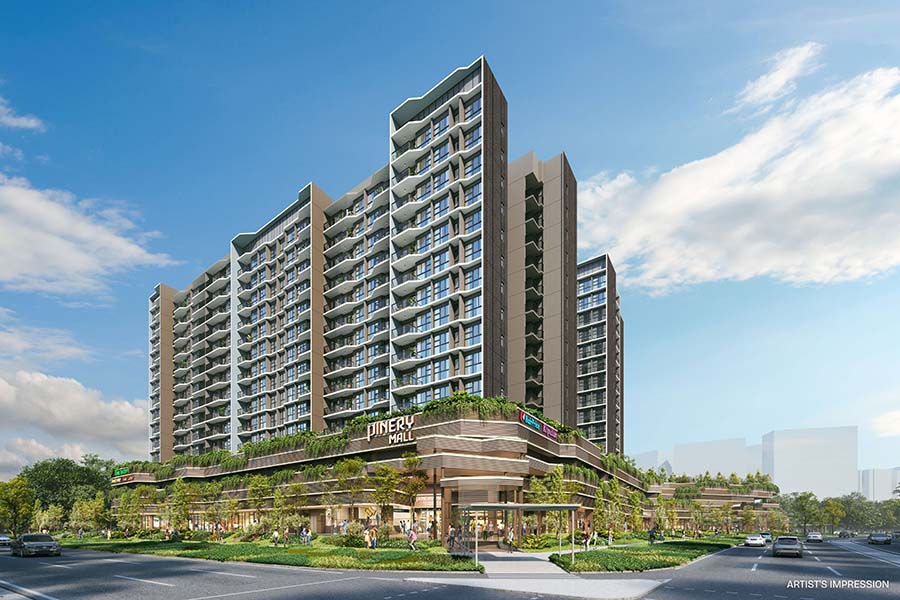
Choosing a residential neighbourhood involves more than comparing property prices and travelling distances. The surrounding population, building arrangements, pedestrian activity and availability of shared spaces can influence how residents experience their homes.
For some households, a busy town centre offers convenience and a lively environment. Others prefer quieter surroundings with fewer commercial activities and less pedestrian movement.
Neither preference is inherently better. The important consideration is whether the neighbourhood’s character matches the household’s expectations.
Singapore’s residential landscape offers different urban environments, from established suburban estates to locations where residential, retail and transport facilities are closely integrated.
The Sunday Morning Test
Imagine two households spending a Sunday morning at home.
The first family enjoys walking to nearby shopping destinations, having breakfast outside and using public transport for weekend activities.
The second household prefers quieter mornings, fewer visitors around the residential entrance and more separation between home and commercial activity.
Both families may value a conveniently located condominium, but their expectations of neighbourhood living are different.
This illustrates why buyers should experience an area at different times rather than judging it through a daytime property presentation alone.
Four Characteristics That Shape a Neighbourhood
1. Pedestrian Activity
A location beside transport facilities and shopping destinations may experience considerable pedestrian movement.
This can be convenient for residents who regularly use public transport or visit nearby businesses.
However, households that value quieter surroundings should investigate the position of residential entrances, pedestrian routes and nearby commercial spaces.
Visit the area during weekday mornings, evening commuting periods and weekends to understand how activity changes.
2. Building Arrangement
The relationship between residential buildings and surrounding developments can influence privacy and natural light.
Buyers should examine site plans, building elevations and the positioning of neighbouring structures.
A development’s overall land area does not reveal everything about the experience within individual apartments.
The location of windows, balconies and common spaces should be considered alongside the surrounding urban environment.
3. Shared Residential Spaces
Condominiums provide shared spaces that residents may use for recreation and relaxation.
However, the usefulness of these areas depends on their actual design, capacity and management.
Families should consider whether the proposed common areas support their preferred activities.
For an upcoming development, buyers should distinguish between confirmed facilities and illustrative marketing material.
4. Commercial Activity
Mixed-use developments introduce another consideration: the relationship between residential and commercial functions.
Retail businesses can make daily errands more convenient, but the location of loading areas, service entrances and customer access points also matters.
Buyers should understand how commercial operations will be separated from residential areas.
Case Study: Living in a Town-Centre Environment in Yishun
North Park Central offers an interesting example of a planned mixed-use residential development.
The project involves the redevelopment of Yishun 10 at 51 Yishun Central 1, District 27.
Frasers Property is associated with the planned 99-year leasehold development, which is expected to contain approximately 110 homes with two- to four-bedroom configurations.
The residential apartments are planned above a street-level retail podium, with a landscaped facilities deck on Level 2.
The development site measures approximately 39,125 square feet and has a gross floor area of around 117,376 square feet, with a plot ratio of approximately 3.0.
Its location beside Yishun MRT station, NS13, and the Yishun Integrated Transport Hub places it within an established transport environment.
An underground link to Northpoint City is listed at approximately 0.09 kilometres.
Other nearby locations identified by the project website include:
- Yishun Polyclinic, approximately 0.31 kilometres.
- Yishun Pond Park, approximately 0.46 kilometres.
- Yishun Primary School, approximately 0.47 kilometres.
- Khoo Teck Puat Hospital, approximately 0.69 kilometres.
- SAFRA Yishun, approximately 0.80 kilometres.
These figures represent straight-line distances from the project website. Actual walking routes may differ.
The proposed arrangement may interest households that value an established town-centre setting. However, buyers should also investigate residential privacy and the separation between retail and apartment areas.
The existing Yishun 10 is scheduled to close on 2 March 2027. According to the project website, the preview is planned around May 2027, the launch is targeted for mid-2027 and completion is expected in 2031.
These dates remain subject to confirmation.
Prospective residents can follow North Park Central for further information as the redevelopment progresses.
A Different Residential Setting in Tanah Merah
Not every buyer wants a residential environment centred around an integrated retail destination.
Bedok Rise Residences is a planned 99-year leasehold condominium at Bedok Rise, Tanah Merah, District 16.
Marketed by Allgreen Properties, part of Kuok Group, the site measures approximately 20,293.6 square metres.
Its maximum gross floor area is 32,470 square metres, with a plot ratio of 1.6.
URA awarded the site to Bellis Residential Pte. Ltd. on 2 December 2025 following a tender that closed on 27 November 2025.
The winning bid was S464.8million,equivalenttoapproximatelyS1,330 per square foot per plot ratio. URA indicated that the site could potentially yield around 380 homes.
The development is beside Tanah Merah MRT station, EW4, on the East-West Line. The station is planned as an interchange with the Thomson-East Coast Line.
The project’s marketing gallery identifies Bedok Mall, Sceneca Mall, Changi Business Park, Jewel Changi Airport and Singapore Expo among nearby destinations.
Buyers considering Bedok Rise Residences should investigate the eventual site layout and residential arrangements before deciding whether the location suits their preferred neighbourhood environment.
The unit mix, building height, architect, completion date and prices have not been released.
Three Household Profiles: Which Environment Fits?
| Household profile | Important considerations |
| Young working couple | MRT accessibility, dining and commuting convenience |
| Family with children | Residential privacy, nearby services and practical outdoor spaces |
| Older homeowners | Pedestrian accessibility, healthcare and quieter surroundings |
These are starting points rather than fixed rules. Individual household preferences can differ considerably.
How to Inspect a Neighbourhood Properly
A short visit to a sales gallery cannot fully represent the surrounding residential environment.
Instead, conduct your own neighbourhood assessment.
- Visit on a weekday morning.
- Return during the evening peak.
- Explore the area on a weekend.
- Observe traffic and pedestrian movement.
- Identify quieter walking routes.
- Check the location of commercial loading areas.
- Examine the surrounding buildings.
- Consider whether the neighbourhood feels comfortable after dark.
For uncompleted developments, review official site plans and request clarification about access arrangements.
Final Thoughts
High-density residential environments can offer convenience, connectivity and access to established amenities. However, these advantages should be weighed against personal preferences concerning privacy, pedestrian activity and residential atmosphere.
North Park Central and Bedok Rise Residences illustrate two different planned residential settings in Singapore.
Neither should be judged solely by its transport connections or surrounding shopping facilities.
Both project websites are developer-marketing sources, so published figures should be independently verified.
Ultimately, the right neighbourhood is one where the surrounding environment supports the way a household wants to live, both inside and outside its apartment.
More Stories
Understanding Singapore’s Total Debt Servicing Ratio: A Practical Guide for Condo Buyers
Natural Light at Home: What Property Buyers Should Know About Unit Orientation
Beyond the Floor Plan — How Everyday Convenience Shapes Singapore Homebuying Decisions